Showing posts with label books. Show all posts

Thursday, March 27, 2008

The revolution will be televised on NBC and hosted by Bob Hope

Most film bloggers love the Oscars as much as the movies they write about. It's a tricky, kind-of shameful dual love, since the Oscars are needless and distracting and not really about the art as much as the ego and the cash. Occasionally, though, constructive theses can be built around both movies and the awards for which they are nominated. So, attention guys and gals of the film blogosphere: You should buy "Pictures at a Revolution: Five Movies and the Birth of the New Hollywood." Those five movies are the best picture nominees from 1967, and writer Mark Harris uses them and their makers as the protagonists (or anti-heros) in a story about the passing of the torch (or fight to death) between Old and New Hollywood, which was figuratively acted out on the stage of Santa Monica Civic Auditorium six days after the assassination of Martin Luther King Jr.

Half of the nominees seemed to be snearing at the other half: The father-knows-best values of Guess Who's Coming to Dinner were wittily trashed by The Graduate; the hands-joined-in-brotherhood hopes expressed by In the Heat of the Night had little in common with the middle finger of insurrection extended by Bonnie and Clyde. ... What was an American film supposed to be? ... In the last year, the rule book seemed to have been tossed out. Warren Beatty, who looked like a movie star, had become a producer. Dustin Hoffman, who looked like a producer, had become a movie star. And Sidney Poitier, who looked like no other movie star had ever looked, had become the biggest box office attraction in an industry that still had no idea what to do with, or about, his popularity.


It was the year of dragons versus dragonflies, as Harris paraphrases The Los Angeles Times. In one corner: Stanley Kramer, Katharine Hepburn, Spencer Tracy, Rex Harrison, Darryl Zanuck. In the other: Mike Nichols, Hal Ashby, Arthur Penn, Warren Beatty, Faye Dunaway. All of these players collided with each other at the '68 Oscars, a ceremony that took Hollywood's temperature just as it was getting feverish. Toward this suitable climax Harris threads his narratives: Will Bonnie and Clyde writers Robert Benton and David Newman ever bring the French New Wave to America? Will Harrison self-destruct before his picture (Doctor Dolittle) does? Will audiences recoil at the notion of Hoffman as a leading man and sexual being? Will Poitier and Rod Steiger move race relations forward or backward with their performances of an accomplished (yet sexless) black man and a bigoted (but vulnerable) white man? Will Tracy croak before completing his scenes?

The inherent drama of producing movies unites these five stories. Virtually everyone who worked on these films was yolked with crippling insecurity, Harris finds, and it's fascinating to read just how unsure Hoffman, Penn and Norman Jewison were about their tasks. Harris illustrates with bluntness and sly humor how the best picture nominees went from pie-in-the-sky dreams or commercial gambits to disasters-in-the-making to either critically immortalized triumphs (Bonnie and Clyde, The Graduate), critically reviled bombs (Dolittle) or best-picture winners (In the Heat of the Night). The juiciest bits of the book are the gems from interviews with Hoffman and Nichols. A whole other book could be devoted to their manic anecdotes, and I would love to see the raw transcripts of Harris's interviews.

Much has been written about the second golden age of cinema, but most of the literature focuses on the rebellion and not the establishment. Harris gives equal play to Old Hollywood's arthritic grapplings, led symbolically by dedicated boozer Rex Harrison, who (along with wacko wife Rachel Roberts) is given the most delicious characterization and emerges from "Pictures at a Revolution" as a kind of silver-screen British Caligula. Leading the rebel forces was Nichols, a tough-as-nails maverick who perhaps was unaware of his own position and power at the center of all the change. If only he and Harrison could've worked together. (I envision a picture called Whiskey before Breakfast, wherein Harrison plays a bluegrass musician who discovers he is the second coming of Jesus Christ and tries to manage two followings, one religious and one musical. Nichols directs, of course. Ashby writes and edits. All are nominated, Harrison wins and tries to swallow his Oscar onstage, tumbler in hand.)

When Harris brings us to the Oscars, there's genuine suspense (even though we know who wins) because of what's at stake, both personally for the players and creatively for the industry. This is where Hollywood discovers what it's really thinking now, and what it's capable of next. The conferral of those stupid statuettes had not meant so much before, and has not meant as much since.

Saturday, October 28, 2006

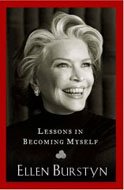
Ellen Burstyn's "Lessons in Becoming Myself"

This post is the first in a series on Ellen Burstyn and The Exorcist, a film I have not seen since 7th grade and swore never to watch again. Eleven years later, it is sitting on my desk in a Netflix envelope. I am looking at it right now. I am terrified to watch it. But watch it I will. I plan to notate my terror as I watch, and write a post immediately after finishing it. If I finish it. If I start it.

I biked to Olsson's yesterday to pop in on Ellen Burstyn, who was signing her memoir, Lessons in Becoming Myself. She looked good. White-haired, purple-suited, and wearing a wrist brace. I got there about 20 minutes after the start time, and no one was around except for a couple handlers. Ellen was signing copy after copy for the store. I'd like to think that a 73-year-old actor would be delighted by a visit from a 23-year-old guy who wasn't even born when she was doing her most important work. But she was as unaffected and calm as when I first met her in New York after Long Day's Journey into Night in 2003.

"What's your favorite movie so far this year?" I asked.

"The Departed," she said in that wobbly-yet-stalwart voice, "although it wasn't the greatest."

I wanted to respond: "So do you feel responsible for Martin Scorsese? After all, it was you who sought him out to direct Alice Doesn't Live Here Anymore when he was a nobody in 1973. He directed you to your Oscar, and then went on to make films that are regarded among the greats. If it wasn't for your initiative, maybe no one would've noticed him."

I wanted to take her to lunch and have her spill her goddamn guts, but, well, it was only appropriate to say, "Thanks for doing this. Goodbye, Ellen."

"Bye Dan," she said.

Her memoir is very good, and I'm not generally keen on memoirs. Most feel forced, as if the celebrity feels he or she is required to conjure one once they stumble into their emeritus years. But Burstyn has lived a full and dramatic life, and it glitters with consequence on the page. She had a wretched mother, an absent father, regular beatings and mental abuse, an abortion at 16 that rendered her infertile, a psychotic husband who hounded her, trouble with alcohol and drugs, a primo spot on Broadway as a young lady with Jackie Gleason, a spiritual awakening in Europe and a fruitful apprenticeship with Lee Strasberg. And that's not the half of it.

"Lessons in Becoming Myself" works because we actually feel a chemical change in Burstyn as she grows from a needy wild girl in destructive relationships to a grounded actor with an unflappable work ethic. The book starts with shards of diary entries from her childhood and starts to crystallize only around page 133. Burstyn chronicles this change in the arena of her gradual spiritual awakening, which centers on Sufism. It's a book about the small-but-crucial choices that make or break movies, but it's also about Burstyn's self-actualization and how it fits into those movies. She gets into some heavy holistic-mystical stuff, and while passages on these matters tend to run long, they never seem fake or wishy-washy. It works for her. And her religion, Sufism, is founded on the search for truth. Lessons in Becoming Myself is its own search for truth.

Some excerpts, for those who want the Cliff's Notes version:
After the scene [in The King of Marvin Gardens], Bruce [Dern] said to me, "Now, get it. You are one of the five best actresses in America. I'll name them," and he counted them on his five fingers. "There is Kim Stanley, Geraldine Page, Julie Harris, Maureen Stapleton, and you."

[An episode of Gunsmoke] was on television the other day and I watched it, more than thirty years after I made it. It's such a strange experience watching your young, thin, pretty self, while you sit on your sofa icing your arthritic knee, feeling every one of those years and probably the same number of added pounds on your aging body.

I struggled with the decision [to attend the 1971 Academy Awards] until the last moment. I even attended the rehearsals. I saw my name pinned to the seat where I would sit. Something about it seemed so cruel. Each one of the names pinned to a seat represented a life that had fought to get to the point where they were doing good work in a good film. Five of us in each category were cited, but only one would win. The others would be losers. It seemed so unfair. And a loser by dint of one vote or a thousand. Didn't matter. A loser.

After the party Billy [Friedkin] and I got in the long white limousine to go to the Whiskey A Go Go with Francis [Ford Coppola]. Driving down Sunset Boulevard, we pulled alonogside a car with Peter Bogdanovich and Cybill Shepherd. They'd been at the party, too. Billy rolled down the window of the limo and shouted across to Peter's car, "French Connection, five Academy Awards." We raced on. Suddenly Peter zoomed by us shouting out his window, "Last Picture Show, best movie since Citizen Kane." Francis told the drive to catch up. As he stood on the seat putting his head through the roof, he shouted, "The Godfather, one hundred fifty million dollars." They were all screaming with laughter, with success, and with the promise of what would become a classic decade in film history.

Many people, including me, consider [The King of Marvin Gardens] to be Jack Nicholson's best work. In my opinion, everything he is credited for in About Schmidt he did earlier and better in The King of Marvin Gardens.

Coupled with news that Billy [Friedkin] had used Mercedes McCambridge's deep voice to overdub some of the demon's lines, the impression was that Linda [Blair] had done far less than she actually did [in The Exorcist]. Billy and others, including myself, feel that's why Linda didn't win the Oscar she deserved. She was a sweet, innocent adolescent girl who gave one of the scariest and most difficult performances in the history of motion pictures. She should have been granted that award.

[The Exorcist] is a classic and has lasted longer and is shown more often today than any of the films we were in competition with [for the Oscars] at that time.

One of the [Tehran Film Festival] officials told me that The Exorcist had not played in Iran because each of the three times they tried to dub it, the dubbing cast got too frightened and couldn't complete it.

I was the shepherd of [Alice Doesn't Live Here Anymore]. I use that metaphor because there wasn't a title for what I was. I should have been executive producer. ... I was an actress in a film that I had brought to Warner's, sold to them, and hired the director. That's what a producer does. Why didn't I ask for credit? I was asleep -- asleep to who I was and what my value was.

[Charles Grodin] refrained from kissing me [in Same Time, Next Year] until the first performance before a live audience in Boston. Then he kissed me and he really did it. I had the sensation of an electric charge moving from where our lips met, down my body, and landing smack in my number-two chakra! ... I told Charles how I was feeling and what I thought about it. I suggested we have our love affair
only onstage. He agreed, and that's what we did.

By mid-September [1977], I'd returned to New York and the challenge of dealing with the dark forces manifesting in my life. In that period I was probably the only actress in Hollywood who was initiating her own projects. Yet with all the heady success, when I went home to my beautiful house and three-acre garden, I lived in fear for my life. So far, every time Neil appeared there was someone there to protect me. But I lived in terror that someday he would find me alone and kill me.

[Before shooting the film version of Same Time, Next Year], Alan [Alda] and I went out on a tear and, I have to say, it was fun. I don't remember too much of it, except at one point we went into a supermarket that was still open, though the bars had closed. There was a big wire bin of bech balls and my memory is of Alan and me running up and down the aisles playing catch. There were no other people in the store except one cashier who was about to close up for the night. He watched our hilarity warily. He had an expression that said: I'd like to throw those drunks out of here, but am I crazy or is that Alan Alda and Ellen Burstyn?

I didn't win the Oscar [in 2000]. It was Julia Roberts's year. ... But I know what I did in
Requiem.

So do we. Read the book and then watch Requiem again. You can see Burstyn drawing on every aspect of her rough-and-tumble life to tackle Sara Goldfarb. Coincidentally, it is Julia Roberts 39th birthday today. You got away with murder, Jules, in 2000. Enjoy that Oscar. It's Ellen's.

Thursday, October 05, 2006

'I think it's true: she tries to be what you want her to be'

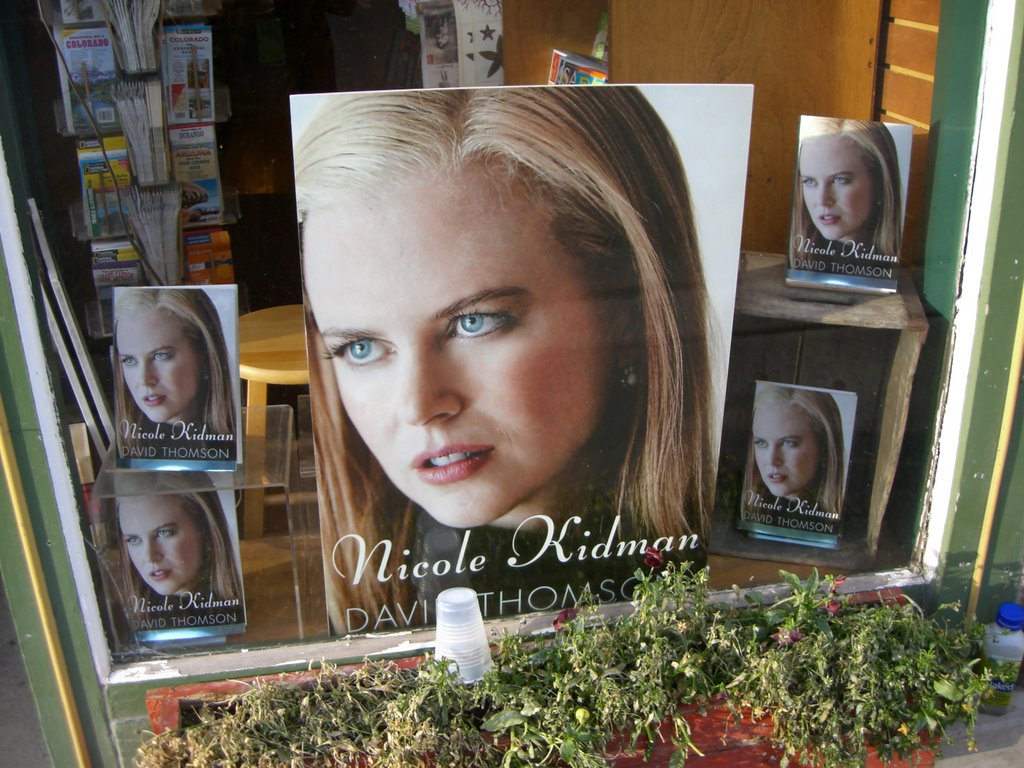
That quote is David Thomson on Nicole Kidman in his new book, scandalously titled "Nicole Kidman." It is an outgrowth of his last intriguing book, "The Whole Equation," which featured a lengthy tangent about Kidman. In this new one, he gives himself 270 pages to slobber over her.

It is a glib book. It feels like the rumination was rushed, even though he gets into crazy specifics, like when he traces back to when the first Kidmans arrived in Australia in 1839. There is a ridiculous chapter on how Nicole must smell, and how her ad campaign for Chanel No. 5 somehow relates to the concept of celebrity endurance. There are bright spots, especially when he speculates on what ended the Kidman-Cruise marriage. He also fills in the blanks of Kidman's personality, which in real life always comes across as shifty at best, incomplete at worst. But there is a fire and ambition in her, if we are to believe Thomson. It's certainly evident in her filmmaking, though.

Thomson says he wrote the book to "honor desire," and he admits that sometimes he seems to be "on the brink of erotic collision with Ms. Kidman" in his dreams. Despite the admission, Thomson's schoolyard ogling is sometimes pervy:

...it may be easier to focus on the critical intersection in the enjoyment of To Die For: the fertile gap between the dumb cunning of Suzanne Stone and the brilliant innocence of Nicole Kidman ... the two personae fit together as tidily and as prettily as...well, as Kidman's breasts in the violent-colored underwear she sports in one scene.

And sometimes I was desperate for footnotes, like when Thomson relates this anecdote about Kidman and Tom Cruise meeting Stanley Kubrick at his house in Hertfordshire:

[Kidman and Cruise] sat on the sofa holding hands while he told them about the picture. "He'd look at her," said Kubrick, "and she'd look at him and he'd say, 'Okay, Nic?' and she'd say, 'If it is with you.' They're a truly married couple. It was kind of touching." Later, when the marriage was over, Nicole will say they lived in a bubble.

When and where did they say this? C'mon, Thomson. This may be a love letter, but you still need to cite your sources. And there are two glaring errors that should not have eluded any editor of any film book. Thomson writes that Kidman won the SAG Award in 2002 and that she was a shoo-in for the Oscar. Not so. Zellweger took the SAG for Chicago -- and Diane Lane and Julianne Moore were heavy critical favorites -- so Kidman's win was not a sure thing. And Thomson writes that Anthony Minghella won a screenplay Oscar for The English Patient. C'mon! That was Billy Bob Thornton.

Anyway. I devoured the book because this is my thing: think pieces about movies. Thomson's writing is delicious, generally. He puts Kidman in a context, which she's always eluded because her work is so varied and her personal life so enigmatic. After finishing the book, I am eager to revisit To Die For and Moulin Rouge!, and to see Dead Calm for the first time. It's quite a filmography, as Thomson reminds us.

What are your feelings about the woman, dear readers? Love her or hate her, and why? What's her best work, and her best moment? For me, well, I love her. When I think of Kidman's brilliance, I think of the moment she says, in The Hours, "I can't think of anything more exhilirating than a trip to London." Go back and look at her face, her eyes, the way she sucks the very life out of her cigarette, knowing the tobacco will never match the terrible ecstasy churning in her brain.

Related posts: The ravishment of Birth, Kidman in Fur, The algebraic sweep of thomson's "Whole Equation."