Showing posts with label The Triple Crowners. Show all posts

Wednesday, May 28, 2008

7. Liza Minnelli, the glutton for adoration

LIZA MINNELLI, 1946- . Triple crown achieved in May 1973 at age 27 with an Emmy for Liza with a Z. Preceded by a leading actress in a musical Tony for "Flora the Red Menace" in 1965 and a leading actress Oscar for Cabaret in March 1973. Followed by a leading actress in a musical Tony for "The Act" in 1977.

There is an entertainer gene. We know this because Liza Minnelli inherited it. She's purebred from Judy Garland and Vincent Minnelli, whose families go back five generations in the theatre or the circus. Liza came out strange-looking: eyes too big and too far apart, body gangly, nose out of proportion, speaking voice queer, singing voice unconventional. But her essence was undeniable. She was a performer. The entertainer gene exists. She proved it. She proves it. It's not about looks. It's about a specific energy that vibrates from the core of one's being.

The first time she set foot on a Broadway stage, the Tony was hers. It would be the first of five major awards procured by interpreting material by composer-lyricist team John Kander and Fred Ebb. It was 1965. Minnelli was 19. Though her voice "is not yet distinctive," wrote Howard Taubman in The New York Times review of "Flora the Red Menace," "she is going to be a popular singer, all right." Not yet distinctive? Perhaps her vocal thickness was a little too close to her mother's at such a young age.

That would change by 1973. Garland was four years dead and Minnelli finished the Triple Crown in a two-month span. Cabaret was first. "Liza Minnelli plays Sally Bowles so well and fully that it doesn't matter how well she sings and dances, if you see what I mean," wrote Roger Ebert, implying her voice and movement aren't as impressive as her general verve."In several musical numbers ... Liza [first name only, of course] demonstrates unmistakably that she's one of the great musical performers of our time. But the heartlessness and nihilism of the character is still there, all the time, even while we're being supremely entertained."

This is the finale scene of Cabaret, and the essence of her Oscar-winning performance is minute 2:42 to around 3:08, and then on to the finish. "What good is sitting all alone in your room..." she sings, losing her smile for perhaps the only time in the movie, staring wide-eyed at the future, or down into the abyss. And then, "...come! Hear the muuusic play..." where she seems to snap a smile out of the air, and allow her head to almost float away (Fosse's camera abets this free-wheeling emotion), her searching eyes paving the way for the clarinet's trill. "Life is a -- cabaret, old chum," she says, as if this conclusion just occurs to her, and then a genius gesture follows for "Come to the cabaret," under which she thrusts her left arm out at the darkness and beckons frantically with her green fingernails. Watch her mouth. It is defiant, joyous. Watch her eyes. They are crying.

It's a perfect marriage of actor and part. The Oscar came in March '73, almost a full year after the film's release. Watch her acceptance here, in which she offers her trademark cackle-gag-sneeze-giggle before speaking graciously: "Thank you for giving me this award; you've made me very happy." It was her second nomination in four years, and the last one she'd ever get.

Two months later, she won an Emmy for Outstanding Single Program (Variety or Music) as the "star" to Bob Fosse and Fred Ebb's "producer" credit in Liza with a Z. It was not its own "individual performance" award (such a category didn't exist), but Minnelli was cited within the category for her performance. And holy shit, what a performance.

Liza with a Z -- recorded live in May '72 at the Lyceum Theatre -- is Minnelli's triumph. It's her without a character standing in the way. It's the gold standard of one-woman shows (though she is aided by a hard-working ensemble). The song "Yes" is an amazing opening. So hopeful, so grateful, so affirming. Yes, yes, yes. (It's why Stritch opens her current show with "Yes I Can".) Minnelli looks out adoringly at her audience. Her "yeses" are so gossamer, the giggles when she gets applause at the end are so coarse and lovely. "You're really terrific!" she squeals at the audience more often than once. She loves the audience. The feeling is mutual. The two feed off each other.

But this is not just reckless abandonment. Her technique and Fosse's execution are flawless. The song "Say Liza (Liza with a Z)" is a lyrical feat of diction and pacing. "Son of a Preacher Man" is sublime and a great way to mix up the showtunes.

Minnelli is a pro at interpreting songs, evidenced by the way she guides us through a fictional marriage in "You've Let Yourself Go." She combines technique, energy, precise interpretation and stunning costuming in the show-stopping "Ring Them Bells," below.

A second Tony came came in 1977 for The Act, a loosely knit star revue that didn't splash like Cabaret or Liza with a Z, but by then she had endeared herself to fans who would stick with her through every kind of public embarrassment and personal ailment. And things got pretty bad for Minnelli -- Judy Garland bad -- and her talent eroded. But what we have in Cabaret and Liza with a Z is a time capsule of raw talent mediated by a masterful director. The helix of her DNA are no doubt beaded with confetti. Almost-nuclear power bursts from her, for better or worse. She may not be the world's best singer, dancer or actor, but she lacquers each with her own brand of italics. And we, almost inexplicably, are captivated.

Ben Brantley summed it up in The New York Times when Liza took over Victor/Victoria from Julie Andrews in 1997: "She asks for love so nakedly and earnestly, it seems downright vicious not to respond."

This is the seventh part of The Triple Crowners, an 18-part series celebrating the performers who have won an Oscar, a Tony and an Emmy. Coming down the stretch is No. 8, a character actor who honed his onscreen reputation as a lovable curmudgeon. Catch up on previous installments of the series here. As always, comments are most welcome: did they deserves these honors? Do the awards validate them or distract from their real talents? What does it all mean?

Thursday, March 20, 2008

6. Paul Scofield, a true man, for all seasons


PAUL SCOFIELD, 1922-2008. Triple crown achieved at age 47 with an Emmy for outstanding single performance by an actor in a leading role for "Male of the Species." Preceded by a best actor Tony for "A Man for All Seasons" in 1962 and a best actor Oscar in 1966 for recreating the role onscreen.

Following Anthony Minghella and Arthur C. Clarke into the hereafter, Paul Scofield completed another celebrity death triptych yesterday. He died at 86 in the south of England, leaving only six living Triple Crowners.

This post will be massively deficient. To know and appreciate Paul Scofield is to have experienced his work onstage and I, of course, was not privileged to have seen his portrayals of Hamlet, Lear and Salieri and his interpretations of Ibsen, Shaw and Marlowe. I have seen him in two movies: 1994's Quiz Show, for which he nominated for an Oscar, and 1966's A Man for All Seasons, for which he won. In both movies he plays men of principle who do not waver under extreme circumstances.

"Your name is mine!" he growls at Ralph Fiennes, who plays his cheating son in Quiz Show.

"I am commanded by the king to be brief, and since I am the king's obedient subject, brief I will be," he says before his execution in A Man for All Seasons. "I die His Majesty's good servant, but God's first."

Two thirds of his Triple Crown he owes to Robert Bolt, who wrote the stage play and screenplay for "A Man for All Seasons," in which Scofield plays Sir Thomas More, the English statesman who stood up to Henry VIII. The film, for me, is a bore. Scofield's character seems to exist in spite of it. It's a humble performance, befitting both More and Scofield himself, who refused a knighthood in the '60s and eschewed all manner of limelight. He never went to the Oscars or gave a TV interview, never engaged in self-promotion and always returned to his family when the work was done. He was impervious to any kind of corruption, small or large, however inconsequential. View the clip below to see how he invests More with his gracefully adamantine spirit.


"Male of the Species," a Hallmark movie that won him his Emmy, seems interesting but remains unavailable for rental. He, Sean Connery and Michael Caine play three iterations of malehood and, of course, Scofield represents the principled and fatherly. A man so disciplined and pure in his personal life was able to approach each role as a blank slate, to sublimate his imposing physical features depending on his task. This was a man with an utter lack of vanity.

What I still would love to see: He and Katharine Hepburn in A Delicate Balance, in John Frankenheimer's The Train and, of course, in Zeffirelli's Hamlet and Branagh's Henry V. If anyone out there has more personal or qualitative thoughts on Scofield, please leave them in the comments.

This is part six of The Triple Crowners, an 18-part series celebrating the actors who have won an Oscar, a Tony and an Emmy. Check back soon for part seven, featuring one of the most terrific (truly terrific) performers of all time. Or catch up with previous installments here.

Thursday, November 01, 2007

5. Melvyn Douglas, the renaissance man

MELVYN DOUGLAS, 1901-1981. Triple crown achieved at age 67 in 1968 with an Emmy for outstanding single performance by an actor in a leading role in a drama for "Do Not Go Gentle into That Good Night." Preceding it were a Tony for best actor (dramatic) for "The Best Man" in 1960 and an Oscar for best supporting actor for Hud in 1963. Following it was another Oscar for best supporting actor in 1979, for Being There.

Melyvn Douglas -- born in Macon, Ga., to a concert pianist, and grandfather to Illeana Douglas -- never graduated from high school. Didn't need to; he honed his acting in Shakespearean repertory in the Midwest. He served in both world wars, was a staunch liberal activist (his wife of 50 years was a three-term Congresswoman from California) and made four films a year from 1931 to 1942 -- the first era of his career.

His career can, in fact, be divided into two such eras: the years in which he supported his leading ladies and the years in which he supported the quality of his projects. Douglas, a stage actor by training, spent the first part of his Hollywood career in the '30s playing opposite Gloria Swanson, Claudette Colbert, Irene Dunne, Marlene Dietrich and Loretta Young. He three times supported Joan Crawford and Greta Garbo (they're pictured in Ninotchka above). As David Thomson writes in The New Biographical Dictionary of Film, Douglas normally played the "escort, husband, lover, or good friend to every love queen of the 1930s and 1940s."

He went into World War II with the U.S. Army and returned to the states in roles that were less romantic and more focused on his advancing years. He was, in essence, a man who reinvented himself by playing principled characters confronting age (renaissance by way of mortality!). Douglas found his rhythm in the '50s ("For years he has been giving pleasant, facile performances in superficial parts. It is always exciting to see an accomplished actor suddenly take on stature,'' wrote the critic Brooks Atkinson of Douglas' performance as Clarence Darrow in "Inherit the Wind" on Broadway in 1955) -- culminating in the 1959-1960 season, when he starred in two plays and won his first major acting award by playing a "principled presidential aspirant" (according to The New York Times) in Gore Vidal's "The Best Man" on Broadway. (Couldn't find a review of this one.)


His next major award came in 1963 with Hud, in which he played Homer Bannon, the inflexibly stern father to Paul Newman's jackass ranch hand (see the above clip for an illustration of their ruined relationship). Here is what Bosley Crowther wrote in The New York Times: "Melvyn Douglas is magnificent as the aging cattleman who finds his own son an abomination and disgrace to his country and home. It is Mr. Douglas's performance in the great key scene of the film, a scene in which his entire herd of cattle is deliberately and dutifully destroyed at the order of government agents because it is infected with foot-and-mouth disease, that helps fill the screen with an emotion that I've seldom felt from any film.''

What is the emotion? It's grief harnessed and restrained by his character's steely will. Homer Bannon grieves his sons -- the responsible one who died and the reckless one who got him killed. He now grieves the calculated extermination of his infected cattle -- the only legacy that matters to him. Douglas plays the scene with brutal simplicity. "Don't take long to kill things," he mutters. "Not like it does to grow." After he himself shoots his last two bulls (no doubt symbols for his spoiled progeny), he growls to his nephew, "Drag 'em away and bury 'em. Bury 'em quick. Go on." He's talking about his hurt, too, and his grief.

In an earlier scene, Homer admonishes Hud because he "doesn't care about nothin'." It's the scolding we've been waiting for, but the payoff is bitter. Homer backs Hud into a doorframe (and into the camera) and spits gravel at him after Hud suggests they drill for oil to make ends meet. "I'd rather herd cattle than drill for oil," Homer growls. "Stuff that keeps a man doin' for himself." And Douglas plays Homer like a man who's had to do everything for himself.

Douglas was not present at the Oscars to accept the trophy -- not sure why -- so his costar Brandon de Wilde did the honors.

His Emmy came for his performance as a retired cabinetmaker (replacing Fredric March at the last minute) who rages against old age in the aptly titled "Do Not Go Gentle into That Good Night," a CBS Playhouse movie also starring Shirley Booth, who was (until then) the most recent attainer of the Triple Crown. Douglas plays Peter Schermann, who tries out nursing homes at the urging of his children. The movie is not available anywhere, so it remains unseen by me. I'd love to see Douglas and Booth together, though. They were masters of the stage who trumped their unglamorous looks with charisma, and snagged leading film roles. (Pictured in the photo above is director George Schaefer, with Douglas to the left and Booth to the right. A young Lois Smith is all the way to the left.)

The second Oscar came at age 78 for Hal Ashby's existential dada anti-farce Being There, in which Douglas plays a billionaire at death's door. Benjamin Rand, couched in his giant mansion, is a much warmer man than Homer Bannon, and Douglas' voice, by this point in his life, had gone from gravelly to paper-thin. There's a sweetness in his eyes, as Douglas allows Rand to be seduced by the utter nothingness of the Peter Sellers character. In this way, he elicits great pity for Rand, who, like Homer Bannon, is a decent man rendered impotent by circumstance.

Douglas didn't attend the ceremony this year either. "The whole thing is absurd," he was quoted as saying. "Me competing with an 8-year-old!" He was referring to his fellow nominee, Justin Henry, the boy from Kramer vs. Kramer. It was not reported whether Douglas was being principled or egotistical. Liza Minnelli accepted for him.

So Douglas won his Oscars for two wildly different roles: a man of privilege and status, and a lowly farmer with a gruff sensibility. But both are on the verge of death (as was his Emmy-winning character), even though he played the roles almost 25 years apart. Neither have big scenes or speeches or even particularly theatrical deaths (and both men do die onscreen); these performances do not fit the textbook definition of Oscar-worthy. Yet, ultimately, Douglas received film acting's highest honor by playing them not just as men on the verge of death, but as men at the end of something -- whether it be end of faith, in Homer's case, or, in Benjamin's, the end of idealism.

This is part five of The Triple Crowners, an 18-part series celebrating the actors who have won an Oscar, a Tony and an Emmy. Check back soon for part six, featuring a paragon of British urbanity. To catch, read posts on previously profiled triple crowners Thomas Mitchell, Helen Hayes, Ingrid Bergman and Shirley Booth.

Sunday, September 16, 2007

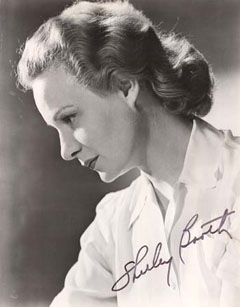
4. Shirley Booth, the maid and the matron

SHIRLEY BOOTH, 1898-1992. Triple crown achieved at age 63 in 1962 with an Emmy for outstanding continued performance by a lead actress in a series for Hazel. Preceding it were three Tonys for dramatic roles -- best featured actress for "Goodbye, My Fancy" in 1949, best lead actress for "Come Back, Little Sheba" (1950), best lead actress for "Time of the Cuckoo" (1953) -- and an Oscar for lead actress for Come Back, Little Sheba (1952). Followed by another Emmy for "Hazel" in 1963.

She was acclaimed for never having given a bad performance, according to The New York Times. This is totally believable, given that she was only in four movies ever. Her stage and radio credits were much more extensive and her legacy was truly cemented by her television work -- specifically "Hazel," that cutesy-tangy domestic comedy from the early '60s. Booth played a sassy, dowdy maid. Nothing like a sassy, dowdy maid to jolt the archetypal stasis of the mid-century American family. The show's damn boring but very populist. Like a latter-day "Two and a Half Men." (Sidebar: Is there anything more depressing than the phrase "season premiere of Two and a Half Men"?) Bleh.

She hit the jackpot with Hazel and was lucky and prolific with roles on stage (600 roles in stock before she went Broadway) but rarely parlayed them to film. Three other actresses earned Academy Award nominations for recreating Booth's role in film versions of her plays: Ruth Hussey in The Philadelphia Story (1940), Rosalind Russell in My Sister Eileen (1942), and Katharine Hepburn in Summertime (1955). But she struck Oscar gold with the one role she did parlay to the screen (in her film debut): that of Lola Delaney, a housewife who is "old and a fat and sloppy" (Lola's words) and puts on a good face despite her brittle marriage to alcoholic Burt Lancaster, the child she miscarried years before, and the lost dog in whom she invested her maternal feelings.

In Come Back, Little Sheba, we first see Booth bumbling down the steps in her bath robe, her steel-wool hair frizzed, taking wide steps, scratching herself. Her voice is like Fran Drescher sucked a bit of helium. Kind of like Estelle Harris, who played George Costanza's mother on "Seinfeld," mixed with Jean Stapleton. Booth as Lola is all jambs and shanks and milky limbs. Maybe she used to be pretty. Maybe not. She lumbers around, always on her toes. She has the let-me-please-you demeanor of a labrador, panting and excited and tail wagging, but quick to shrink when accused or abused. It's one of those performances that appears very static for most of the movie, with subtle choices showing the truth beneath the ignorant exterior.

These choices won Booth the Oscar. When she listens to a silly radio program, she starts dancing and then lays down on the couch and goes into a kind of trance. The exotic music takes her away and makes her more conscious of where she's trapped. Her eyes water a bit. Then there's the way her face starts to crinkle when she realizes Lancaster is backsliding. Or her subtle and perfect reaction when Lancaster mumbles a term of endearment during a alcoholic haze: a twinkle of a tear, but no tremor. She lifts her face and head slightly, as if she's inflated with just a little bit of self-worth. "That's me," she says.

And then there's that final monologue when she describes a dream, her eyebrows bobbing up and down expressively. "Dreams are funny," she concludes.

Reviews of all her stage performances were glowing. "The stage begins to glow the moment she steps on it and the audience melts, like a crowd of children whose imagination has been captured by someone they trust," Brooks Atkinson wrote about her in the 1954 musical "Two if by Sea." "No one else in the theater has made native decency so human, so triumphant and so captivating."

Booth exemplifies the archetype of the triple crowner. She earned her reputation on the stage, carried that to less extensive but equally valuable film work, and then won a pair of courtesy Emmys for bothering to stick with a primetime role for six years. For what it's worth, Booth was happy to be doing Hazel. "Why not enjoy Hazel's success?" she said to a colleague. "I'm as pleased as I can be. I like my work."
The is part four of The Triple Crowners, an 18-part series celebrating the actors who have won an Oscar, an Emmy and a Tony. Check back soon for part five.

Tuesday, August 28, 2007

3. Ingrid Bergman, the most beautiful face in the movies

The first two triple crowners were more character actors than movie stars, though their pedigree and filmography might suggest otherwise. Thomas Mitchell and Helen Hayes were accomplished and revered, but neither had the stardust that bursts from the screen every time Ingrid Bergman casts her eyes this way and that. Flick, flick, burst, burst. A firework display of grace with every look.

I wish I could give you a full essay on Bergman, but several factors will delay this indefinitely:

1) Despite its claims to the contrary, my Netflix area does not have the 1944 version of Gaslight, Bergman's first Oscar-winning performance.

2) I ordered the 1944 version on Amazon, but it was lost in the mail.

3) I'd have to pay Amazon $68 to see her Emmy-winning performance in "A Woman Called Golda." I can't bring myself to do that, especially when things get lost in the mail.

4) I'm leaving for Telluride on Thursday morn, and I don't have time to scour the indie rental places, watch the footage and write about it before then.

Eventually we will loop back and discuss Bergman (whose birthday is tomorrow! How perfect would it have been if I actually had the post ready). But do not fear -- I have studied up on our No. 4 triple crowner, and will blog about her in the next few days. Who is she? She's brassy. She's doughy. And she brings us back into character actor territory...

Thursday, August 16, 2007

2. Helen Hayes, first lady of the American theatre

HELEN HAYES, 1900-1993. Triple crown achieved at age 52 in 1953 with an Emmy for best actress for a variety of TV appearances, including "Schlitz Playhouse of Stars," "Pulitzer Prize Playhouse" and "Robert Montgomery Presents." Preceding it were a best leading actress Oscar for The Sin of Madelon Claudet (1931) and a best actress (dramatic) Tony for "Happy Birthday" (1947). Following it were a best actress (dramatic) Tony for "Time Remembered" and a supporting actress Oscar for Airport.

Hayes was and is the pride of Washington, D.C., where she was born to a poultry salesman and an actress, where she made her professional debut at age 9, and where she is immortalized as the namesake of the region's theatre awards. This five-foot, 100-lb dynamo worked in every decade of the 20th century and was to the stage as Katharine Hepburn or Meryl Streep is to the cinema: deeply and broadly talented, capable of striking any tone, with a virtually unassailable legacy.

Alas, I wasn't around to catch her on stage, though there was ample opportunity. Hayes was on Broadway 60 times before making her talkie debut in The Sin of Madelon Claudet, and followed that role with 40 more appearances. One hundred performances on the Great White Way. Impressive. It's not surprising that she won her first Tony the year they were created -- for the comedy "Happy Birthday," which Anita Loos wrote specifically for her when Hayes complained she was sick of playing noble queens.

In addition to a regional theatre award, Hayes also has a Broadway house named after her. When it was dedicated in 1982, The New York Times reported that Hayes made a point of showing disdain for the use of microphones in the theatre by standing to the side of the lectern and speaking without amplification.

"Even though I couldn't be on the stage, I took comfort that I was still represented on Broadway,'' she said. ''The theater has been my whole life. It has given me every great thing I ever had. I hope this theater will have many long runs and outlive me."

When she had her first starring stage role as a flapper in 1920 in "Bab," the reviews weren't so glowing. Heywood Broun dismissed her as "cute," which a term that tailed her for years. "On opening night, I gave one of those shrill, tense performances that became a hazard in my career whenever I was not in top form," she admitted later. So she worked to get better. She improved her voice and delivery and concentrated hard on seeming taller. "My posture became military," she said. "I became the tallest five-foot woman in the world."

She followed her writer husband Charles MacArthur to Hollywood and was polished enough by 1931 to win an Oscar for The Sin of Madelon Claudet, in which she aged 30-some years in 76 minutes. Hayes plays Madelon, a woman who is abandoned by her husband and left alone to care for their infant son. Madelon sends her son to be raised by friends in the country, marries a rich man in order to provide for the son, gets caught up in the second husband's malfeasance, goes to jail for 10 years, is released, seeks out her son but tells him his mother is dead, tries to find a job to surreptitiously pay for his schooling and ends up becoming a whore to finance her son's dream to become a doctor. Keep in mind the son has no idea she's alive, even though they've met face to face.

"Let's face it," said producer Irving Thalberg. "We win Academy Awards with crap like Madelon Claudet."

And Hayes did. The movie is rather silly, but Hayes is fun to watch. With her wide-set eyes, apple-pie voice and spritely manner, her appearance and acting feel surprisingly contemporary and unaffected for a 1931 movie. She's an unconventional beauty in a bullseye of an Oscar role: Madelon is pretty, then ugly. Young, then old. A chaste mother, then a whore with a heart of gold. She gets to flit around in a lacy dress early in the movie, and then skulk around in old-lady makeup at the end. It set the Oscar mold for all the future pretty ladies who would uglify themselves for a decent part. Hayes won the Oscar over two competitors, Marie Dressler and Lynn Fontanne (also a first lady of the theatre). Despite the senseless plot of the movie, Hayes deserved the honor. Her performance exists on its own plane and somehow remains free of the movie's contrived logic. Why? Because she's so damn charismatic and likeable.

Adequately prepared by Madelon Claudet, Hayes played over 80 years of Queen Victoria's life in the 1935 Broadway production of "Victoria Regina," which was considered her greatest stage triumph (no Tony, though -- they had not been created yet). "Tremulously magnificent," wrote critic Brooks Atkinson in The New York Times. "Since the Queen is dead, God rest her soul. Let the cheers go to her actress, who deserves all the homage the town contains."

She made a fifth as many movies as she did pieces of theatre, but struck Oscar gold again 40 years after Madelon Claudet in the ridiculous, shameless disaster movie Airport. Hayes, then 70 years old, plays Ada Quonsett, a serial swindler who sneaks onto airplanes without paying. She shows up 23 minutes into the film to hop a flight to Europe. She's wearing a brown hat with a brown pompom and a tweed coat with a black velvet collar. She is white-haired and cute as a button, but is nevertheless caught by security and sent to the office of the airport general manager (played by Burt Lancaster).

She charms him, saying that she was taking the trip her husband had always wanted to take. "He always said, 'See Rome, and die,'" she simpers. "But he died while we were packing."

Jean Seberg, who plays another airport official, sees right through the act and encourages security to be on the lookout for a "sweet-looking innocent old lady" after Quonsett sneaks out of Lancaster's office. What if she gets onto the plane after all? "She deserves it," Lancaster says. "She's fabulous."

She is fabulous, isn't she? Hayes is the welcome comic relief in a too-serious movie, the cheery antidote to Maureen Stapleton's potent grandstanding. Quonsett does get on the plane and is conveniently seated next to a would-be bomber (ah, there's the plot!).

Eventually she is enlisted by the flight crew to act as an abused passenger to distract the bomber. As part of this ruse, we get one of cinema's great moments: Jacqueline Bisset (playing the stewardess) slaps the first lady of the American theatre.

Hayes is in command of a decent role in a shoddy movie (like she was in Madelon Claudet). She plays a geriatric con artist, so she gets to perform within a performance. Look at her fake-weep in the above clip, and that awful face she makes when she wails "You hurt me!" Delightful. Selfless. Somewhere along the line, the bomb goes off and we last see Quonsett huddling under a fur coat with a nun, taking pulls on a bottle of airport brandy. So it's funny. It's kitchsy. But an Oscar? Sure, the competition wasn't extreme (Hayes faced Stapleton, Lee Grant, Karen Black and Sally Kellerman), but still...

Hayes became the first person to have both a leading and supporting Academy Award on her mantle. She wasn't at the ceremony. Rosalind Russell accepted on her behalf (it was the closest Roz got to an Oscar).

The next year, Hayes guest-starred on "Here's Lucy" in an episode called "Lucy and the Little Old Lady." You guessed it: Hayes plays the Little Old Lady, who looks and acts an awful lot like Ada Quonsett, and who also happens to be a con artist. The episode is a yawn -- you can tell Lucille Ball's time had passed -- but Hayes is a gas. Her entrance is met with canned applause. Even the fake audience is aware of her stature. But Hayes isn't afraid of getting goofy. The seance scene -- in which Hayes tries to summon the spirit of Napoleon Bonaparte -- is pretty great. Even though she won her Emmy nearly 20 years before, I'm mentioning this television appearance because it's the only one I could find on DVD. So sue me.

Helen Hayes, Helen Hayes. If we look at Madelon Claudet, Airport and "Here's Lucy," what are we to make of her? A young lady who could play old, and an old lady who could play goofy. I wish I could've seen her on stage, which obviously filled in most of her greatness. The theatre side of her triple crown weighs heaviest.

Hayes's view of her eminence was modest. "Without the compensation of glamour, I am hard put to explain the durability of my career and the loyalty of the audience," she wrote in a 1968 memoir titled "On Reflection." "Perhaps it is just identification. I was once the typical daughter, then the easily recognizable wife, and then the quintessential mother. I seem always to have reminded people of someone in their family. Perhaps I am just the triumph of Plain Jane."

The is part two of The Triple Crowners, an 18-part series celebrating the actors who have won an Oscar, an Emmy and a Tony. Check back soon for part three, featuring the second most beautiful woman in the movies. The collage at the top of this post is from http://www.stevemoore.addr.com/, and is used without permission. Forgive me.

Wednesday, August 01, 2007

1. Thomas Mitchell, the character actor's character actor

THOMAS MITCHELL, 1892-1962. Triple crown achieved at age 60 in 1953 with a Tony for best actor in a musical for "Hazel Flagg." Preceding it were a best supporting actor Oscar for Stagecoach (1939) and a best actor Emmy (1953) for his work on several programs, including "Robert Montgomery Presents," "Tales of Tomorrow," "Lights Out," and "Studio One."

Nineteen hundred thirty-nine was a banner year for film and a banner year for Mitchell. In that one year, he was featured in Gone with the Wind, Mr. Smith Goes to Washington (above right), Only Angels Have Wings, The Hunchback of Notre Dame and Stagecoach (above left), for which he won the Oscar over his Mr. Smith castmates Harry Carey and Claude Rains. It was a nice convergence: Mitchell deserved it for Stagecoach and deserved it for his cumulative work that year.

There's something very familiar and modern about Mitchell in Stagecoach. He plays the drunkard-physician Doc Boone, an affectionate man who provides the heart, soul and comic relief for this otherwise melodramatic -- I'm looking at you, Claire Trevor -- wagon picture. Mitchell was 46 while filming Stagecoach. Philip Seymour Hoffman, who shares Mitchell's gift for balancing comedy and gravity on a scale of frumpiness, just turned 40. When Hoffman hits 50, the resemblance will be even stronger. These men do not fit the mold of the matinee idol, but they are still leading men and fine actors. It's a function of charisma and commitment. One's appearance is molded to fit the part.

In Stagecoach, Mitchell is whiskered and phlegmy, always taking pulls from a bottle of whiskey. A top hat, bushy eyebrows and coattails are part of the ensemble. He enters the picture as comic relief, stumbling and bumbling in a drunken stupor. "I'm not only a philsopher, sir, I'm a fatalist," Boone says at one point. "Somewhere sometime there may be the right bullet or the wrong bottle waiting for Josiah Boone. Why worry when or where."

His role deepens as the plot advances. Notice the kind bedside manner he affects after delivering Mrs. Mallory's baby, and his grandfatherly tone as he advises Trevor how to proceed romantically with the Ringo Kid (played by John Wayne). It's the prototypical supporting Oscar performance: a funny sideshowman has the chance to shine dramatically.

Mitchell won his Emmy like he won his Oscar: by dint of his ubiquity. Mitchell was a featured player or guest star on no less than half a dozen programs leading up to the 1953 Emmys, and I was able to get my hands on a DVD of "Tales of Tomorrow," a forerunner to "The Twilight Zone." In an episode called "The Crystal Egg," Mitchell plays a professor who is able to see the Martian landscape in, well, a crystal egg. It's based on a silly H.G. Wells story. What matters, again, is Mitchell's commitment to the material. He's not coasting on his looks (he can't), and he's not phoning it in, even though it's a silly TV show. He plays this crazy professor for all he's worth, but stops short of caricature. It's really quite striking -- the restraint and the energy.

The Tony came shortly after. Mitchell played one of the leads in the Jule Styne musical "Hazel Flagg," which was based on the Carole Lombard movie Nothing Sacred and opened in the Mark Hellinger Theater (now the Times Square Church) six days after he won his Emmy. His onscreen persona seems like it would translate gloriously to the stage, though I do wonder about his singing voice...

The is part one of The Triple Crowners, an 18-part series celebrating the actors who have won an Oscar, an Emmy and a Tony. Check back soon for part two, featuring one of the first ladies of American theatre.

Wednesday, July 25, 2007

The Triple Crowners: An Introduction

Trophy-giving is a fickle activity -- a function of timing and momentum as much as talent -- but it's less of an "accident" or passing fancy if a performer is able to lock down the triple crown of acting awards: the Tony, the Oscar and the Emmy. Eighteen people have done this. It's a rarified sphere of actors. Hilary Swank may have two Oscars (deserved, says I -- shut up), but she probably will never be grouped in the same category as these 18 people, whose versatile talent was able to thrive in three different media over the course of many years.

Who are they? You can probably think of one or two right off the bat. Let me help: They are seven men and 11 women. Seven of the 18 are still alive -- the youngest is 57, the oldest is 85. On the list, there are 10 Americans, five Brits, a Puerto Rican, a Swede and a Hepburn. I'll start profiling each of them next week, beginning with the first man to complete the triple crown (one of film's great character actors) and ending with the most recent joiner (an icon for 35 years and still delivering). When possible, I've reviewed the films and TV shows for which they won their Oscars and Emmys. Unfortunately, their performances on Broadway are lost to the ages, though I did see one triple crowner's Tony-winning turn in person in 2003 (the award was massively deserved, of course).

Why do this? Anyone who loves movies or pop culture loves the silly exhiliration of obsessing over awards, but identifying and appreciating the triple crowners is more useful than silly -- together, they paint a definitive portrait of accomplishment in the performing arts over the past 80 years. These 18 actors are/were blessed with both talent and the respect of their peers and critics. It's a panorama of skill and wattage. It's about great work admired greatly, and it says a lot about ourselves as connoiseurs. So let's celebrate 'em.

Five items before the series begins:

1. I'm just focusing on performers. Eight non-actors (all men) have also attained the triple crown: director Mike Nichols, writer-director-"actor" Mel Brooks, composers Marvin Hamlisch and Richard Rodgers, orchestrator Jonathan Tunick, composer-conductor Ralph Burns, writer Sidney Sheldon and director-choreographer Bob Fosse, who turned the triple crown into a grand slam; Fosse won all three awards in 1973 (an Oscar for Cabaret, an Emmy for "Liza with a 'Z'" and two Tonys for "Pippin").

2. I'm not including performers who've attained the triple crown by winning in non-acting or non-competitive categories. For example, John Gielgud and Whoopi Goldberg have all three awards, but they got their Tonys for directing and producing, respectively. In addition to her two Oscars and five Emmys, Barbra Streisand was awarded a special Tony -- but it was a non-competitive "Star of the Decade" designation. Like an honorary Oscar, it doesn't count here.

3. Now, a word on toughness. Of the three, the Oscar is the hardest to pocket. It's given in the narrowest industry (the heavenly bodies really have to align for you to make it to the proverbial podium) and has the narrowest field (only 20 acting nomination slots per year, compared to 40 for the Tonys and a whopping 80 for the Emmys). The Emmy is, of course, the easiest; dozens of channels/networks provide limitless entrees into the pool, and performers in a recurring series have the chance to win the award every year they're on the air. The Tony falls somewhere in the middle. It's great for recognizing new and untested talent (people come out of nowhere to win), but it restricts itself to only three dozen venues (large theater houses) in just one city (New York). An actor might give the performance of his life in a small dive on the Lower East Side or in a regional theater in the Poconos or San Diego, but it won't count for a Tony. [We're not getting near the Grammys because they're ridiculous. The best music almost never wins, and there are 40,000 categories. Last year, I won Best Non-Musical Non-Recording by a Pale Journalist.]

4. With this scale of difficulty in mind, some luminaries are very close to the triple crown. Meryl Streep, who has a pair of Oscars and a pair of Emmys, hasn't been on Broadway since 1977 -- how is that possible? -- when she received her first and only Tony nomination. If she were to set foot on the proper stage today, she'd join the club instantly. Kevin Spacey, Mercedes Ruehl, Ellen Burstyn, Kevin Kline, Joel Grey and Judi Dench (who herself has a rich history on television) need an easy Emmy to join. Folks, just guest-star on "Two and a Half Men" and you're golden. [Grievance: Cloris Leachman (who has an Oscar and eight goddamn Emmys) could've easily joined the club if she was still attached to Mel Brooks' upcoming stage musical adaptation of Young Frankenstein. C'mon, Cloris.]

5. None of the 18 triple-crowners won their Emmy first. Perhaps this illustrates how hard it is to break out of TV into film and/or theatre. Eleven started off with the Tony, the remaining seven with the Oscar. The Emmy came last for all but four of them. Perhaps this illustrates how Emmys are treated like bonus footnotes -- garnishes, if you will -- on an established star's resume.

This series will launch a week from today -- a medley of aperitifs to contrast the creative sloth of August. Tune in throughout the month for thinkpieces (long and short) on the triple crowners. Be prepared to discuss not only the merits of the actors but also the validity of their awards. The discussion will no doubt take place at the intersection of affection ("God, I love her") and semantics ("God, he should not have won for that"). Before then and in between triple crown posts, there will be the usual grabass...