Showing posts with label obits. Show all posts

Saturday, September 27, 2008

I have vision, and the rest of the world wears bifocals

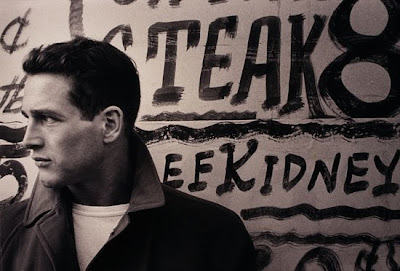
That's a quote from Butch Cassidy and the Sundance Kid. Doesn't make too much sense if you think about it, but you get the idea. Paul Newman saw the world with a clarity that was foreign to most in Hollywood. The best-looking, arguably-most-complete man in the movies died yesterday at 83 of cancer. I'll leave the official eulogizing to the pros. Instead, some memories of Paul from my life, apart from the fact that I always always buy his pasta sauces:

His performance in 1982's The Verdict is a rhapsody, the crown jewel of his career, and should be part of any acting school curriculum. I will never tire of watching him in that movie. With grit and grace, he pilots Frank Galvin from the depths of alcoholism to the ridge of redemption, and is smart enough to bring his character to a place of truth rather than a place of resolution. Watch him closely in the summation scene, as Sidney Lumet slowly moves the camera in on this man -- this man who started so meek but who is now towering in this moment in time, for perhaps the first and last time in his life.


Of course, like any good man, he was a sucker for and splendid practitioner of comedy. He was a vulgar marvel in 1977's Slap Shot. I'd never seen him in an out-and-out comedy, and was continually astonished by the ways he appropriated his dramatics to the business of the low-brow.


I remember the serious silliness of 1974's The Towering Inferno and the cool mugging -- long before Clooney -- in 1973's The Sting. His youthful prime was in the 1960s, with The Hustler (drool) and Hud (see clips in my appreciation of Melvyn Douglas), where he appeared to mature into the man James Dean might've been, but with less suffocating Method and more personality. I'd never accuse Newman of being a chameleon; I've never seen him in a role that required an extreme transformation; he didn't suffer for his art. I've only seen a quarter or third of his filmography, but it seems that he never went that route. His craftsmanship blended his star power with an inner fire, which burned as blue as his eyes and which he could set to simmer or boil, depending on his assignment. If I could live my life over again as a movie star, I'd want to be Paul Newman. He just makes sense to me. The way he worked...the way he lived outside of work...his unyielding self-deprecation and disregard for his looks and talents. Right now, I can hear the talking head on CNN in the background. She's saying he will be remembered for more than just his movies. Which is exactly what he wanted.

I saw him once, in person, at a show in New York. Was it at The Apple Tree? I can't remember. But I remember him, and his wife Joanne Woodward, sitting a couple rows in front of me. In real life, he was a white-haired old man, a dutiful husband, unremarkable in appearance. But I remember thinking, "I'm seeing Paul Newman in real life. I'm seeing him. Remember this." And I have. Now he is dead, but that blue fire ain't. It's forever, like the movies. Here's a nice montage to close the matter for now:


Monday, May 26, 2008

Sydney Pollack 1934-2008

Attention must be paid to the man who holds sway over the green light. He probably hit his directorial peak in 1982 with Tootsie, but Sydney Pollack's record as a producer has always sparkled, especially during more recent years. Thanks in part to Pollack, we have, in addition to the subject of my last post (HBO's Recount), an invaluable quartet of projects from the last two decades:
Update 27 May 08, 12:28 / I should've concentrated on Pollack's cameo in Death Becomes Her, where he plays an emergency-room doctor who makes the gruesome discovery that Meryl Streep -- who is acting perfectly healthy -- has a broken neck and should probably be dead. He can't even find the heartbeat. It's a wonderful little comic turn, in which Pollack descends into utter shock, trailing breathless "uhs" as he's trying to reconcile diagnoses with facts.

"I tell you what, kids, it's, uh, odd thing here. Your wrist, uh, far as I can tell, is, uh, fractured in three places. Uh, and you've shattered, uh, two vertebrae, though I can't be certain without an X-ray. The bone protrusion through the skin -- that's not a good sign. Your body temperature is below 80, and your, your, your heart's stopped beating."

Thursday, October 18, 2007

Deborah Kerr 1921-2007

My favorite of her films is the superb psychological thriller The Innocents (the right clip). When I attended a screening of The King and I in New York several years ago, the singer Marni Nixon — who dubbed Kerr in the musical (and in An Affair to Remember, the left clip) — noted how gracious Kerr was to her. The studio wanted the public to believe Kerr was actually singing, but she was forthright with the press about Nixon's contribution. The two worked hand-in-hand, studying each others physicalities and inflections, to create a believable facade. This speaks of her professionalism and her humanity, which were coiled inside an alabaster beauty (note her most famous scene, in From Here to Eternity in the middle) and unfurled slowly over a grand, concentrated career.

"I have never had a fight with any director, good or bad," she said toward the end of her career (via the AP). "There is a way around everything if you are smart enough." She also told the AP that TV reruns of her old movies have "kept me alive" for a new generation of film fans.

Monday, July 30, 2007

Ingmar Bergman 1918-2007

I did a story on directors and their muses earlier this year, and tried to get both Ingmar Bergman and Liv Ullmann on the phone. Bergman was, of course, unreachable. He died today on the remote island of Faro on the Baltic coast of Sweden. Ullmann, though, was kind enough to call me. It wasn't possible to coordinate a time to talk, though, so she caught my voicemail one day in January before I got to work. Imagine it in a clipped Norwegian accent:

We always know how to get hold of each other both when we are working and when we are not working. By really wonderful mutual understanding. Full of respect. Trust. Recognition. And to be recognized and allowing that to happen. And a deep friendship over 42 years. I think that really sums it up. To recognize and be recognized, to trust and be trusted, and give each other enormous freedom. I give him freedom to allow me to be who I am and he gives me the freedom that I know I’m seen and understood and that makes me very eager to listen to him.

Link buffet: The Washington Post obituary. My thoughts on Ingmar and Ingrid: Careers in closeups. Stockholm weighs in. Woody Allen's immediate reaction, and his review of Bergman's autobiography. Roger Ebert's appreciation.

Below is a clip from of favorite scene from my favorite Bergman movie, 1978's Autumn Sonata (which is being roundly ignored in everyone's appreciations). It features Ingrid Bergman (no relation) as a famous concert pianist and Ullmann as her mousey, unremarkable daughter. You don't need subtitles to know exactly what's going on. Ullmann performs meekly but truly and Ingrid is wracked by pride and resentment and love. This part of the scene is shot back and forth, cutting between Ingrid's reactions and Ullmann's self-conscious playing. Then, in a gorgeous two-shot closeup, Ingmar gives us Ullmann's face as she watches Ingrid invert her praise into an object lesson. Ingmar's choice to film this part of the scene in a two-shot tells us everything we need to know about these characters: Ullmann has been and will forever be looking after (soon in both senses of the word) her mother, who plays without acknowledging the damage she's done to her daughter. And underneath all this is a haunting Chopin piece -- when Ingrid lifts her fingers from the final arpeggiated chord, both women realize they have participated in a clear demonstration of everything that's rotten about their relationship. They are quick to dismiss it, and Bergman's camera follows: At the moment Ingrid kisses Ullmann's cheek, the camera cuts to a long shot, as if it can't bear to witness this hollow effort. This scene is a painful, piercing, beautiful example of Ingmar Bergman's directorial fearlessness. He was not afraid to use the camera as a dagger.

Monday, July 23, 2007

Without László Kovács, we would not have...

...Jack Nicholson, as we knew him at the start of his brilliant career. Kovács, a Hungarian-born cinematographer, died over the weekend in Beverly Hills at age 74. He photographed Nicholson in seven movies between 1967 and 1972: Richard Rush's drug-infused Psych-Out, the Bogdanovich thriller Targets, Bob Rafelson's moody twofer Five Easy Pieces (above right) and The King of Marvin Gardens, and the motorcycle trilogy Hells Angels on Wheels (also directed by Rush), Easy Rider ("You know, this used to be a helluva good country") and The Rebel Rousers (Tagline: "Their creed: 'If it feels good, do it!').

I love this period of Nicholson's career. It's the Drifter Period, which hit its stride with Easy Rider in '69 and culminated with Antonioni's The Passenger in '75 (the year in which Nicholson instead reaped kudos for One Flew over the Cuckoo's Nest). I don't know if he and Kovacs were good friends, or whether they had similar temperaments and therefore made similar career choices, but they both defined each other during this period. Nicholson's acting was reserved and passive. He was, in essence, more reactor than actor. What I remember most about Five Easy Pieces and Marvin Gardens is that Kovács' camera struck the same tone. It was not participatory. It was observational. Rather than see "with" Nicholson, it simple saw him. Kovács' camera did not fawn over this blooming movie star; it kept its distance and allowed him room to grow. I have no idea if the two were active collaborators, but it was a nice marriage. I wish I could be more articulate, but I'd have to give the films another viewing. What I remember from these two movies in particular is that both Nicholson and the camera seemed to be entities in search of something. They didn't find what they were looking for, but they did find each other. And it worked.

But they never again worked together after 1972. Both men's careers would evolve toward populism. Nicholson struck critical gold with Chinatown and Cuckoo's Nest, then entered the Kitschy Period with The Shining, Terms of Endearment, The Witches of Eastwick, Batman, A Few Good Men and so on. Kovács did the same. Though there are many good titles on their filmographies, it does feel a bit like the wild boys tamed themselves over the years. Nevertheless, to send him off, here are some screen shots from Kovács' non-Nicholson work (click on the photos for IMDb info):


Saturday, June 02, 2007

I would've loved to go head-to-head with him in a trivia match

Vocations can get very specific. Take Patrick Stockstill, who only ever wanted to be the official historian of the Academy of Motion Picture Arts and Sciences. Stockstill died last week, but not before serving 25 years as the world's biggest Oscar know-it-all. The L.A. times reports that at 14, Stockstill started keeping track of Oscar winners on index cards, and had 10,000 by the time he realized his dream of working for AMPAS. I admit to doing the same thing at 14, albeit with a computer. Though I could never take AMPAS seriously enough to work for it, I have a strange respect for Stockstill, who knew exactly what he wanted to do and did it.

Thursday, April 05, 2007

Bette Davis eyes

My grandmother -- who died yesterday after enduring a host of ailments for longer than anyone should've and with a quiet resolve few could've mustered -- always reminded me of Bette Davis. Not in attitude; she was a kind and deferential woman in her role as Grandma Pat and was without a trace of Davis' acidity or self-importance. But in the early days of my life (the mid-'80s), she bore a slight resemblance to that great player of unsympathetic characters.

It was the eyes, I think: wide, walnut-shaped. And the lid and eyebrow area: a weighty crescent (I'm loathe to say "droopy" or "sagging" because that denotes lethargy, of which she had none, but you know what I mean). The eyes were the focal point of a woman who was once full-figured and statuesque. A stroke or two changed her appearance dramatically and the "extended stay" in a nursing home in the last chapter of her life dulled her features. In my head I'm picturing a photo of her, my grandfather and me when I was maybe 1 year old, and the Pat I saw this past Christmas was not the same Pat who's in that photo. Life has a way of wearing you down, I guess. If it can wear the immortal Bette Davis down (and boy did it ever), it can wear anyone down. I wish I had that photo in my possession so I could post her opposite Davis.

Anyway. The great thing about memory is also the great thing about movies: We can envision people in the prime of their lives, in moments of clarity and beauty. We can afford the dead a certain immortality. Davis has been dead for almost 20 years, but I can pop in All About Eve and suddenly she's here, in the now now now: 42 years old, crackling with life, enduring. We can skip the memories of her when she was old and infirm and confused, making those embarrassing appearances on awards and talk shows.

And as I remember Davis poised on the stairs in All About Eve, so too do I remember Grandma Pat in those quick, slight moments. Screen captures, if you will: how she used to wear these flannel skirts held together with a massive safety pin, how she made dark chocolate mini turkeys for Thanksgiving and how she always kept a tin filled with M&Ms, how I distinctly remember when she told me her favorite color was yellow (and how my 8-year-old self was fascinated by that choice, since I was convinced everyone's favorite was boring old blue), how her drink of choice was a Manhattan, how she grew mint in the backyard and gave us stale bread to place around the nearby St. Francis bird fountain, the way the stroke made her seem distant and alien but then how she tenderly and covertly stroked my grandfather's thigh last Thanksgiving as they sat side by side.

Last night I went across the street to hear some bluegrass. I ordered a Manhattan, winced with each sip -- I see now why she liked it -- and left the two cherries speared and uneaten.

Wednesday, December 13, 2006

Peter Boyle 1935-2006

Let's pause and reflect on the little moments of perfection Peter Boyle gave us: butchering Puttin' on the Ritz with Gene Wilder and earnestly trying to have some soup with a blind Gene Hackman in Young Frankenstein. In the film, Boyle is essentially doing "silent comedy," which is perhaps the most difficult kind. He does it sweetly, and is the heart of the funniest movie ever made. In Taxi Driver, we see just how good a dramatic actor he was. He makes my blood run cold as Billy Bob Thornton's bigoted father in Monster's Ball. He's a showstopper as the proselytizing mental patient in 1989's The Dream Team. "I have died and been reborn!" he booms in the movie. "I can do it again, buster." If only!

LINK BUFFET: The New York Times obit ("Mr. Canby called Joe one of the 10 worst films of the year but hailed Mr. Boyle’s performance as 'extraordinary'"). / The Archive of American Television's interview ("The highlight of my career was meeting my wife on the set of Young Frankenstein, and having two wonderful daughters"). / The Washington Post obit ("Film critic Gary Arnold ... called him 'as irresistibly uncouth as the early Brando'").

Tuesday, November 21, 2006

Robert Altman 1925-2006

"I've always said that making a film is like making a sand castle at the beach. You invite your friends and you get them down there, and you say you build this beautiful structure, several of you. Then you sit back and watch the tide come in. Have a drink, watch the tide come in, and the ocean just takes it away. And that sand castle remains in your mind. Now I've built about 40 of them, and I never tire of it. No other filmmaker has gotten a better shake than I have. I'm very fortunate in my career. I've never had to direct a film I didn't choose or develop. I love filmmaking. It has given me an entré to the world, and the human condition, and for that I'm forever grateful."

I admit to being nonplussed by Nashville, McCabe & Mrs. Miller, M*A*S*H, Cookie's Fortune and The Long Goodbye -- in this sentiment I am alone in the world of cinephiles, where Altman is worshipped as the greatest of directors. I've never been sold on him. Altman's oeuvre, to me, always seemed like a resounding technical achievement, a mastery of the form but not the emotion behind it. But I loved The Company and The Player for their tenderness and causticity (respectively), and appreciated Short Cuts and Gosford Park for their virtuosity. And, like Sidney Lumet is, Altman was one of the movies' great human beings: generous to other filmmakers, thankful for his luck and status and respectful of both the medium and the power that springs from it.

Does anyone have any favorite moments from Altman films? I like Keith Carradine singing "I'm Easy" in Nashville. I love the final shot of The Company, when we realize that the movie is about love and not dance. And Helen Mirren's modulated confession in Gosford Park -- how still it is compared to the kinetics of the rest of the movie. And I love the sadness that throbs through A Prairie Home Companion, an utterly appropriate swan song. Sure, it was written by Garrison Keillor, but the lines seemed to be spoken directly by Altman.

Lola: What if you die some day?
Keillor: I will die.
Lola: Don't you want people to remember you?
Keillor: I don't want them to be told to remember me.

And as the white-clad moll of Parts Unknown, Virginia Madsen says, "There is no tragedy in the death of an old man. Forgive him his shortcomings, and thank him for all his love and care."

Link buffet & appreciations (as they become available): The eight-minute opening shot of The Player. "We leave his movies knowing that life is many things at once -- at once." Stephen Hunter: "Where others saw theatrical artifice, Robert Altman saw the teeming, throbbing Petri dish called life." JMR.: "It is even arguable that I would not be where I am today without Altman." Looking Closer Journal: Altman, Lynch and a handshake at the 2002 Oscars. Roger Ebert's encounters through the years.